
Project Summary
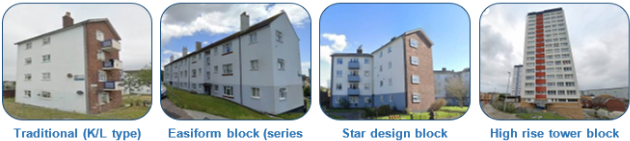
The study took an “archetype” approach to carry out a detailed heat decarbonisation options appraisal for four common block types in Plymouth Community Homes’ (PCH) social housing stock.
For each block types, the study undertook a technical assessment identifying any significant technical barriers of implementing the following low carbon heating technologies:
- Connect to a district heat network
- Direct electric heating
- Ground-Source Heat Pump array
- Air-Source Heat Pumps
The study provides a financial assessment comparing technically suitable low carbon heating options with business-as-usual gas boiler replacement.
Background
Plymouth City Council’s (PCC) planned heat networks are a strategic priority in meeting its for a carbon neutral city. The Council wanted to understand the feasibility of connecting the PCH blocks to the heat network.
PCH’s Environmental Strategy commits to achieving a minimum Energy Performance Certificate (EPC) rating of C by 2030 and net zero by 2050. Many of the residential blocks are coming up for renewal of their heating systems. Existing systems are mainly individual combi gas boilers and PCH wanted to understand the feasibility of low carbon options as alternatives to defaulting to gas boiler replacement to meet the 2030 target.
Our Role
South West Net Zero Hub commissioned consultants Scene Connect to carry out the study and supported Plymouth City Council and Plymouth Community Homes as clients with project management.
Location
Plymouth, Devon
Technology / What Happened
The study assesses the feasibility of a number of low carbon heating technologies against the counterfactual of gas boiler replacement:
- Connect to an ambient 5G district heat network – either directly or through a 4G energy centre.
- Direct electric heating
- Ground-Source Heat Pump array – either centralised plant or individual heat pumps
- Air-Source Heat Pumps either centralised plant or individual heat pumps
Financing and Ownership
The recommended heating options focus on minimising the lifetime cost of providing heat and hot water, while keeping delivery risk and long-term obligations for PCH proportionate to each archetype. How the solutions will be financed is beyond the scope of the study.
Ownership of the low carbon heat technology and responsibilities will depend on the final solution chosen. Retail and bulk supply from a district heat network connection were both assessed. For other solutions, ownership by PCH is assumed.
Results
The study assessed over 1,700 dwellings across four archetypes.
At the High Rise Blocks, connection to the District Heat Network (DHN) is recommended as the most technically and financially appropriate solution for both PCH and residents, even under the high connection charge scenario. At Woodlands Court – situated outside of the District Heat Network Zone – a local Ground Source Heat Pump (GSHP) network is the most viable low carbon solution.
For other blocks DHN connection is preferred for a retail supply. For bulk supply, a reduction in the projected network charges may be needed. Outside the DHN Zone, GSHP is the recommended option for Star and K/L blocks, and distributed Air Source Heat Pump recommended for Easiform blocks.
Heat network connection also delivers the strongest EPC improvements.
For all central scenarios, the whole-life cost of heat for the preferred low-carbon heat alternative is higher than the counterfactual option of installing new gas boilers. This is based on assumed gas prices in 2025 and doesn’t account for prolonged high gas prices or policy changes affecting gas and power prices.
The overall carbon abatement cost for the preferred scenarios ranges from £21 to £266 / t CO2e.
Benefits
The study contributes towards several potential benefits:
- Significant long-term carbon reduction
- Supports Plymouth’s net zero ambitions
- Improved EPC ratings and building performance
- Scalable infrastructure aligned with national policy
- Greater resilience to energy price volatility
- Builds delivery capability for future projects
Lessons Learnt
The archetype approach worked well for the high‑rise blocks as there is a high degree of consistency. Only a small number of model runs were needed to capture top/middle/bottom floor variations.
However, there was significant variation across all the other block types (fabric improvements, orientation, configuration etc) making it very difficult to provide generalised conclusions. A very high number of model runs was needed to account for the variability.
In hindsight, for these block types, a higher level options appraisal to screen out some of the options would be more efficient. Identifying best/worst/typical cases would have been a better approach than modelling every flat.
One of the valuable output of the project is a clear set of agreed assumptions for the modelling of the different technologies, which could be used in other projects and could be updated with real world data over time.
One of the issues in the timely delivery of the project was that list of assumptions being agreed too late in the project. It would have improved delivery to interrogate and agree the assumptions early on before the technical and financial modelling started. However, this would have needed data relating to the heat network earlier in the project. And doing some modelling first enabled the assumptions to be interrogated based on the results which helped identify where there were issues.
Next Steps
For PCC, in the process of appointing the Heat Network Development Partner, the study report can be used to inform engagement between the Partner and PCH. The Council will also use the report to inform its wider net zero roadmap work.
For PCH the study will help inform our strategy with a likely next step to explore a block in more detail and scope a pilot.
Key Facts
| Client | Plymouth City Council Low Carbon Heating |
| Strategic priority | Low carbon heating |
| Timeline | October 2025 – April 2026 |
| Project value | £43,000 xxx |
| Project report | Read the full report on our website |